
Marsh Mallow

Marsh Mallow: Althea officinalis
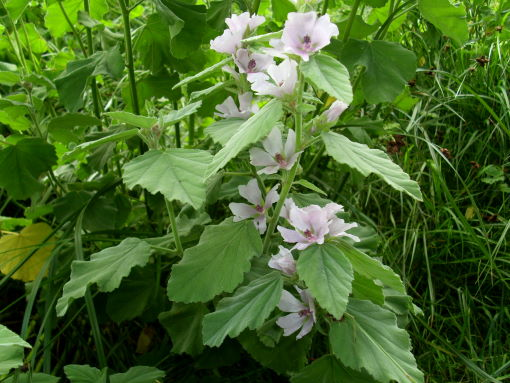

Marshmallow -- the herb, not the white puffy confection roasted over a campfire -- has been used for more than 2,000 years as both a food and a medicine. The Romans, Chinese, Egyptians, and Syrians used marshmallow as a source of food. The Arabs made poultices from its leaves and applied them to the skin to reduce inflammation. Both the root and leaves contain a gummy substance called mucilage. When mixed with water, it forms a slick gel that is used to coat the throat and stomach to reduce irritation. It is also applied topically to soothe chapped skin.38

Few scientific studies have looked at the effects of marshmallow in humans. Most of its suggested uses come from a long history of use in traditional healing systems. However, one recent study confirmed that marshmallow preparations help soothe irritated mucous membranes due to:
  • Asthma
  • Bronchitis
  • Common cold/sore throat
  • Cough
  • Inflammatory bowel diseases (such as Crohn's disease and ulcerative colitis)
  • Indigestion
  • Stomach ulcers
Skin inflammation

Comments

Popular posts from this blog

Uvuma-omhlope

Uvuma-omhlope; Synaptolepis Kirkii Uvuma-omhlope (Synaptolepis Kirkii) is a bluish-green shrub with striking porcelain white roots. Kirkii is traditionally used by the Zulu and Xhosa to induce spiritual visions, trances and dreams. The roots of the Uvuma-omhlope shrub contain a potent neurotrophic called kirkinine. Neurotrophins are a family of proteins that induce the development and function of neurons. UBULAWU DREAM HERBS Uvuma-omhlope is one of the so called ‘Ubulawu’ dream herbs. This is the name associated with a series of plants from Southern Africa that are used for visions and vivid dreams. It is believed one can communicate with the ancestral spirits and gain special insights and answers through use of the Ubulawu herbs. UVUMA-OMHLOPE EFFECTS There has not been extensive research into the workings of Uvuma-omhlope, but based on traditional use and user experiences, the effects are very similar to African Dream Root (Silene capensis). Uvuma-omhlope encoura...

Ubhubhubhu

Ubhubhubhu; Helinus integrifolius Ubhubhubhu is the Xhosa name for a South African herb also known as Helinus integrifolius, though the common name is unknown. Little information can be found on either name, though a study into Xhosa plants and their western names by the South-African Rhodes University suggests the herb may be closely related to the Ilex mitis, a tall evergreen tree indigenous to South Africa. The Xhosa would use Ubhubhubhu in an ‘Ubulawu’ mix. An infusion was taken orally at the initiation of diviners to strengthen memory and give the initiate keen powers of observation. UBULAWU DREAM HERBS Helinus integrifolius is one of the so called ‘Ubulawu’ dream herbs. This is the name associated with a series of plants from Southern Africa that are used for visions and vivid dreams. It is believed one can communicate with the ancestral spirits and gain special insights and answers through use of the Ubulawu herbs. UBHUBHUBHU EFFECTS Helinis integrifolius ha...

English lavender

English lavender;  Lavendula officinalis Lavare is the Latin verb "to wash". The Romans used the fragrance of the blossoms in their bath water hence the origin of the name lavendula. In the Middle Ages, it was used alone or in combination with other herbs to treat insomnia, anxiety states, migraine headaches and depression. The fragrance is relaxing hence the dry blossoms were stuffed in pillows and given to agitated patients to produce sedation. The oil is strongly antiseptic and used to heal wounds.  It is native to the Mediterranean (Spain, France, Italy, Croatia etc.). More:  www.piam.com/mms_garden/plants.html